Friday, 2 August 2024

So where have I been and what have I been up to?

Following The UK Golden Demon in 2022 I dived straight into my next project a unit of Voidscarred Corsairs. I was on a roll coming up with an overall approach to the unit and devising a colour palette. I set to, customising the first of them, which was a thoroughly enjoyable experience, but when it came to start painting everything changed. 

I simply could not bear the idea of picking up a brush and painting a mini! I’ve had times when I’ve gone off painting before but never anything like this. It was a disturbing experience. In part I think it was a delayed reaction to my Nurgle tank and I was experiencing an extreme case of hobby burn out. But I felt there was also a more deep-rooted problem. Over the last five years there’s been a series of major crises in my immediate family. Just as one thing seemed to be over and life looked like getting back to normal we would be engulfed by some new nightmare. 

You can only soldier on for so long without something giving. I’d experienced a bad episode of anxiety and depression back in my mid-forties, so fortunately I recognised the early signs. My hobby seemed to be triggering my mood swings and I decided to take a break from it. So, long story short, I took time out, stepped away from social media and built a lot of Lego! 

It’s not the first time I’ve taken a break from painting, and I was confident it wouldn’t take 23 years this time! Sure enough the desire to paint gradually returned and my Corsairs were ready and waiting when it did. I’ve actually been quietly painting away for my own pleasure since August 2023. It’s been a return to hobby basics painting simply because I love to paint with no additional pressures from posting or competitions.

So it’s time to come back out from under my rock and share my hobby. I started in March this year when I was persuaded by my mate Lee Hebblethwaite to go to the Hammerhead painting competition in Newark. I nearly didn’t enter a model but was persuaded to put my Kastelan Robot in. This model crashed and burned badly at Golden Demon, so I had nothing to lose; it really couldn’t do any worse. It didn’t as it won Gold in its category and then took Best in Show! 


This was a lovely moment of redemption for my Kastelan and it gave a very welcome boost to my confidence. It was so good to meet up with my painting buddies at Hammerhead that it didn’t take too much to persuade me to come to FMS in July. I’ve been hearing nothing but good things about FMS for the last two years but the clincher was an invitation to put a selection of my work on display in the ‘out of contest’ section of the show.

So last weekend saw me heading off to Ely with nineteen models representing forty years of painting. I also had one other model that represented the most recent phase of my painting journey because I’d finished the first of my Corsairs, the Felarch. 

As promised FMS is a fantastic event with the nicest location I’ve ever been to for a painting competition. Best of all were the people and spending time with friends old and new!

The competition featured models that represent the whole spectrum of our hobby and the standard was impressively high throughout. My own experience was a little different from past competitions as no one had seen my Felarch and I felt this gave my mini a kind of anonymity which I rather liked. It’s something I shall have to think about for the future. 

The second day brought the revelation that I’d won a medal, which was a great relief! Having enjoyed so many past successes is a matter of pride but it does come with a certain (self-imposed) pressure to maintain that standard. I’d tried a few new things with my Felarch and, after a painting break, I wasn’t overly confident that I’d done as well with him as I could. I find it quite hard to assess my own work, especially when it’s newly finished.

So I was over the moon to be awarded a Gold medal. But that was then followed by Best in Show which I really didn’t see coming! As comebacks go this could not have been a better experience. 


So now that I am back online and painting: what next? The Voidscarred Corsairs Unit is my current project and at my present rate of painting its likely to take at least a couple more years! It’s my intention to paint each model to my best single figure standard, and that has certainly paid off so far. I will be posting on social media and updating this blog but only as and when I have suitable content. I intend to keep my unfinished work more under wraps than I’ve done in the past. Once a model is finished and has ‘gone public’ I will publish my WIP retrospectively.

The coming year is likely to be a sad one as my family continues to navigate it’s way through difficult times. But I have my passion and enjoyment of painting back and that’s something I’m very thankful for. As the great Winston Churchill said, “Painting is a companion with whom one may walk a great part of life's journey”.


Thursday, 27 October 2022

Project P30 - Part 16b

The End is Nigh - Part 2.


With the exception of the base (and that’s a whole new chapter) the remaining work on my Tank is a matter of finishing things off. Some parts need to be painted from scratch but most of the work involved tying-up lose ends from earlier work.

Fix the hand holding the bell into place.


This was a far more straightforward process than the mecha arm. I simply glued the bell hand in place with plastic glue. Once that had set, I filled the seam with dilute PVA and then retouched the paintwork. This felt like an enormously significant step as I was finally adding the sub-assemblies to the model. At long last it was all coming together!


Fix the chimneys back into place.


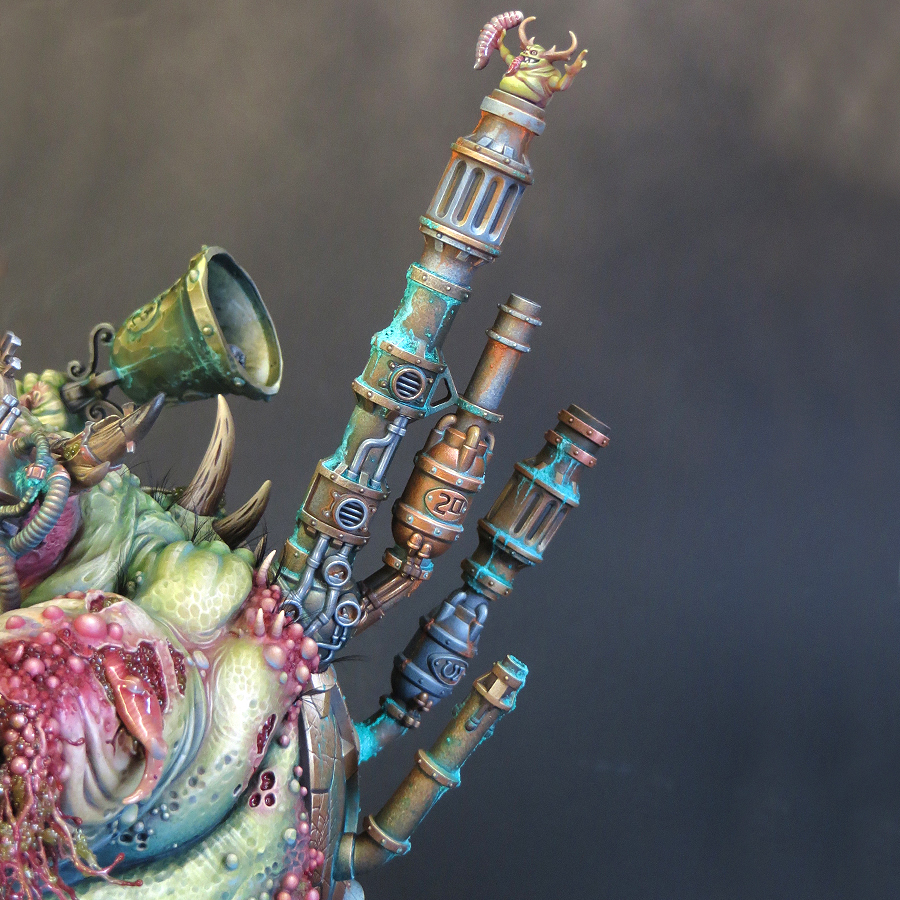
Now things really started to near completion as the re-addition of the chimneys would complete the model’s silhouette. I’d removed the chimneys earlier to make them easier to paint and I’d expected their reattachment to be a tricky process. In the end it went very smoothly. The chimneys were pinned, then glued back into position, leaving relatively minor seams to cover. For the smaller chimney, there was a matter of adding some corrosion over the join. A little corrosion can hide a multitude of sins! 


For the larger chimney, I had to re-sculpt some of the bubbly flesh texture over the join and then fill some hairline cracks with dilute PVA. I also added a few bony spines to this. Overall I’m very happy with the result. In fact, I think this area works better than it did before I removed the chimneys! Painting this area was a matter of matching up the colours to my existing scheme.

I was now finally able to add a long planned feature to the model. Some time ago I decided that I wanted coarse bristles sprouting from the Daemon’s back and shoulders. I’ve used grass tufts and paintbrush bristles to create similar effects in the past. 


My first attempt, using grass tufts, was an instant fail! The ‘hair’ looked too fluffy. Fluffy is not what we want or expect from Nurgle! For ‘plan B’ I used false eyelashes for the hairs which have a curve to them and taper to a point. They proved to be perfect. I cut them into small clusters, or individual hairs, and glued them into place with PVA. Once again this was tricky work but the final effect is exactly what I wanted!

4. Painting the Tentacles


I’ve a notebook with seven years worth of ideas written down for this project. As my plans developed and changed I kept notes to make sure nothing was forgotten. But, by the time I started painting, there were far to many, sometimes conflicting, plans for one project. Much of my decision making has been around which ideas to implement and which to reject. As the scheme developed the process of editing my plans became easier.

The tentacles are an example of the ‘less is more’ approach I’ve taken in the later stages of this project. I’d initially envisioned them as a larger version of the tentacles on Gutrot Spume, complete with stripes and dripping slime. But I felt that the stripes would bring an unnecessary new element to the scheme which would make the tentacles stand out from the rest of the model in an unsatisfactory way. 


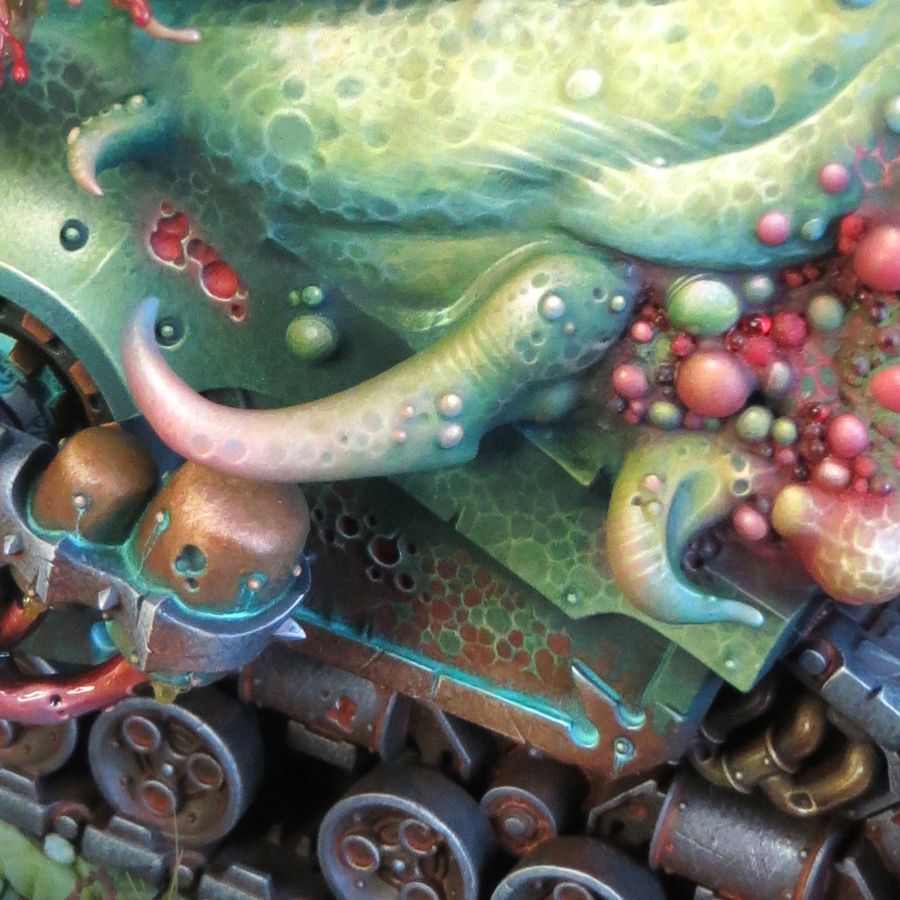
Rather than stripes, I’ve painted the same freehand texture as used on the sides and back of the model. This adds interest to the tentacles but ties them in to the overall scheme. I’ve used colour to make them pop against the rest of the model. Starting from green hues at the base they graduate through a pinkish flesh tone to blue tips. The blue is my old favorite Bering Blue, which I’ve used throughout the scheme. It’s at its most obvious on the tentacle tips.

5. Add drool.


I rejected the idea of slime dripping from the tentacles as being just too much! This also applied to most of my plans for adding extra slime and goo to the model. My tank from 1990 has a liberal application of slime made from PVE glue and then painted. I strongly felt that I already had enough slime and goo on my new model and any more would begin to dominate the painting.

But there was one area where I very much wanted to break out the microbeads and water effects. This was the mouth (the one in the Daemon’s head) where I felt the addition of drool would be beneficial. The mouth was one of the very first areas I painted and its been a long wait to be able to finish it! 


I decided to focus the effect to one side of the mouth rather than filling the jaws with stringy drool. This was done with that old favorite UHU glue. Once the glue had set (it goes rubbery rather than hard) I built up several layers of water effects and microbeads. Once dry I gave it three coats of gloss varnish.

In the final of these updates I’ll describe how I made and painted the base for my Daemon Engine.

Wednesday, 19 October 2022

Project P30 - Part 16a

The End is Nigh!

It will come as a great surprise to anyone if I state that a lot has happened since I last posted regularly on this blog! Not least the long anticipated return of Golden Demon UK at Warhammer World on October 1 & 2. I posted some finished pics here during the weekend of the competion but it’s time to indulge in a little time travel as I bring things up to date.

For some time my gut feeling was that I’d finish the Daemon Engine this year but there’s nothing like a deadline to boost momentum! I felt that, with some effort, the October deadline might be achievable so I decided to go for it. The last few months have seen some adrenaline fueled painting and I now feel more confident about that deadline. Things have been coming together well and the end is in sight!

As I move towards the closing stages of a project I usually create a checklist of things to do. This helps me to keep focused, stay on target and avoid missing anything out in a rush to get finished. It’s been especially useful this time around as there have been many steps to complete. In my next few posts I’ll describe that list of jobs in the order I did them.

Finish the mecha arm.


This arm has been the most physically difficult area of the model to paint so far! In retrospect, I wish I had found a way to paint the arm as a sub-assembly, which would have made things a lot easier. 


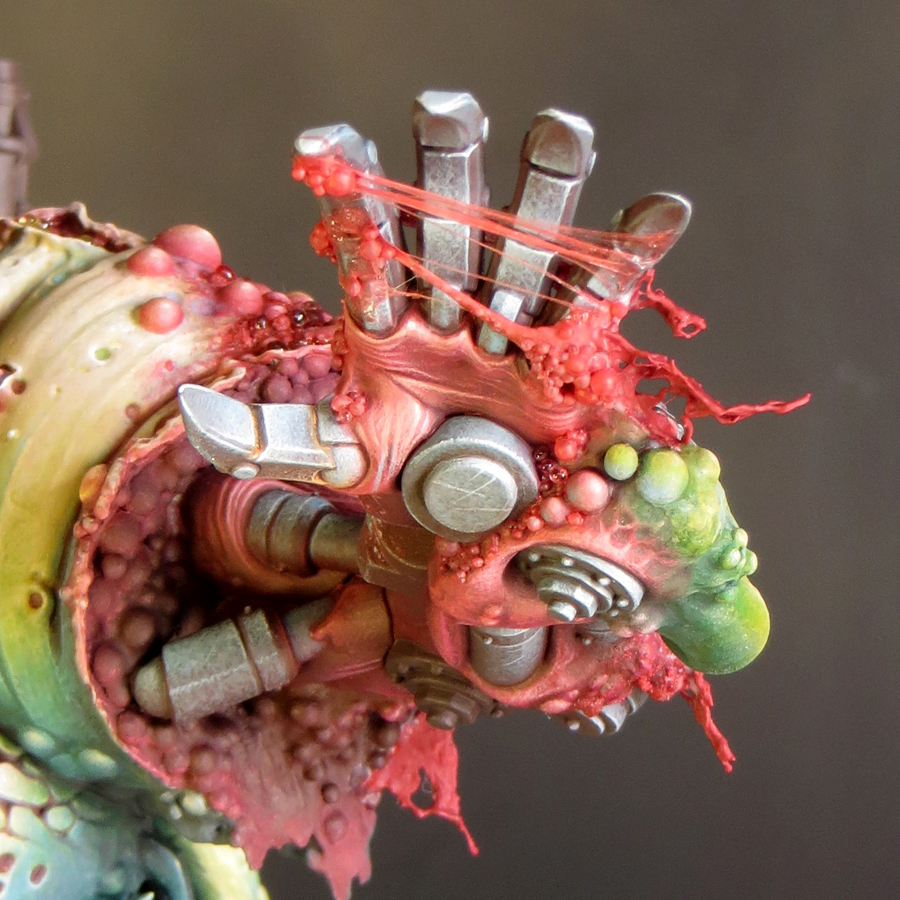
However, the more interesting problem was to address the transitions between areas of flesh and metal. The arm came from the Forge Fiend kit and as such already depicted a union of monster and machine. This was a good starting point. I especially liked the hand as it matched the size of the fleshy hand holding the bell. However, some of the fleshy parts of the arm lacked the definition and texture that I wanted. I built up these areas with a combination of greenstuff, texture paste and microbeads. This had the additional benefit of helping to integrate the arm with the overall scheme by the use of common textures. This applied most especially to the bubbly/blistered texture I’d added elsewhere.

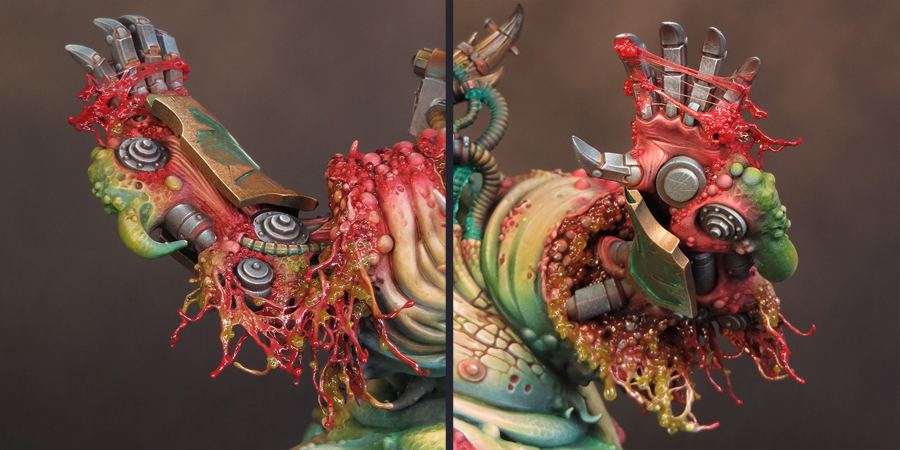
The next task was to address the stump out of which the mechanical arm protruded. Microbeads (of course) provided much of the texture, but I wanted something more. I wanted to create a semi liquid, ragged texture, as if the flesh was in the process of flowing into a new form. My greatest inspiration for this was the writing of Michael Moorcock, and most especially ‘Stormbringer’, which has had a huge influence on how I see the forces of Chaos and their effects. To create the flowing flesh, I used a variation of the cotton wool and water effects splash effect (shown HERE). In this case, however, I used a PVA glue and paint mix instead of water effects. 


I was very pleased with the final effect but the overall look of the arm didn’t feel right to me. After some thought I decided that I needed more metal and machine parts in proportion to the fleshy parts. Taking my nerves in hand, I clipped off the large green tentacle (I was to later use it elsewhere) and added the spikey guard rail from the Plague Burst Crawler. It was a nasty job but I was much happier with the arm once it was done!


Paint the sides of the tank.


I regarded the sides of the tank as three distinct areas: the side panels, the tracks and the entropy cannon. The side panels are especially significant because it was here I wanted to create a major transition between flesh and metal.

I’d decided upon the colours for this transition as a part of my ongoing work. The fleshy parts of the side panels were to be a deep green, transitioning from the lighter green upper parts. I felt that a flashy NMM effect would be inappropriate for the metal parts. So I used a brown hue inspired by patinated bronze. This was the same treatment I’d used on the ‘boiler’ at the back of the tank. It is a colour that contrasts with the green but not in a way that draws the eye away from the focal points of the model.

The transition is created through the use of a freehand texture. This was based upon the painted texture of the upper flesh areas, so it felt like a part of the overall scheme. I’d not been looking forward to painting this transition but, by the time I came to do it, things had become fairly straightforward. All my choices had been made as an on-going part of the project’s evolution, so I was able to focus on executing them rather than worrying about what to do! All in all this was one of the faster parts of the paint scheme to complete. 


Now I could paint the tracks. Once again my choices were informed by my earlier decisions. I kept the scheme for this area fairly simple. I painted the tracks and all the associated wheels, gears and general gubbins in the same dull grey NMM I’d used elsewhere. This would contrast with the adjacent parts of the model but fit in with the overall scheme. I had some plans for adding lots of mud and dirt but decided against this. As things have progressed, I’ve been editing my plans as it is easy to go OTT with this project. There is already a lot going on with the overall scheme. 


Rather than adding heavy layers of dirt, I painted some fairly subtle rust effects and blended them into the brown shadows to give a grimy feel. My global shade colour is Black Leather from Scale Colour which helped with this a great deal. I am particularly fond of shading cool or neutral greys with brown hues. As always, the photographs I took for lighting reference were extremely useful when it came to placing my highlights and shadows!

The final job for this overall area was to paint the two entropy cannons. These were painted as sub-assemblies and provided a nice little sub-project. 


The sides of the tank were the last significant areas of the tank to be painted.

The remaining work consists mostly of finishing things off and bringing together previously painted sub-assemblies.

Thursday, 29 September 2022

Project P30 - Part 15.

It's done!!!

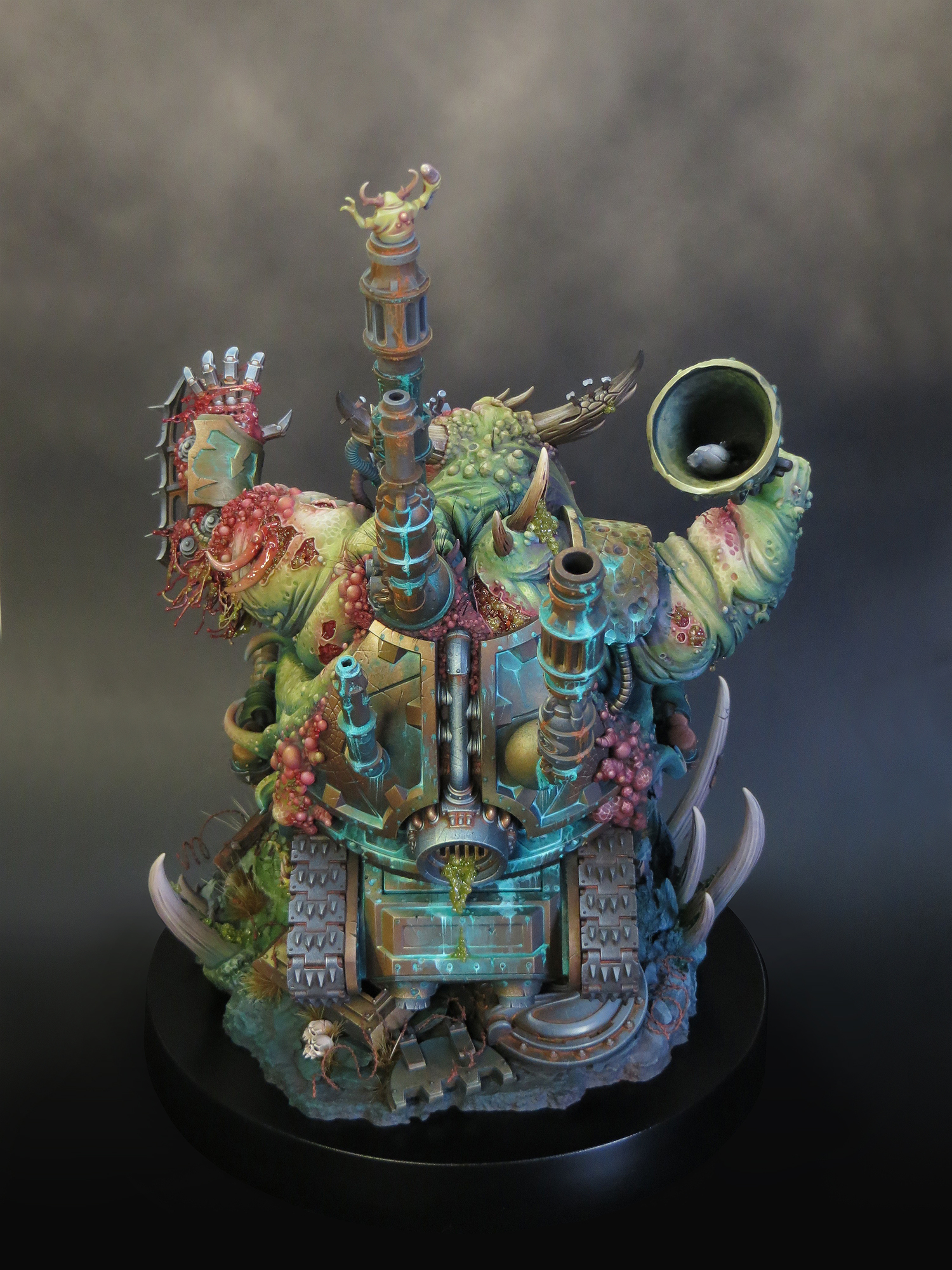
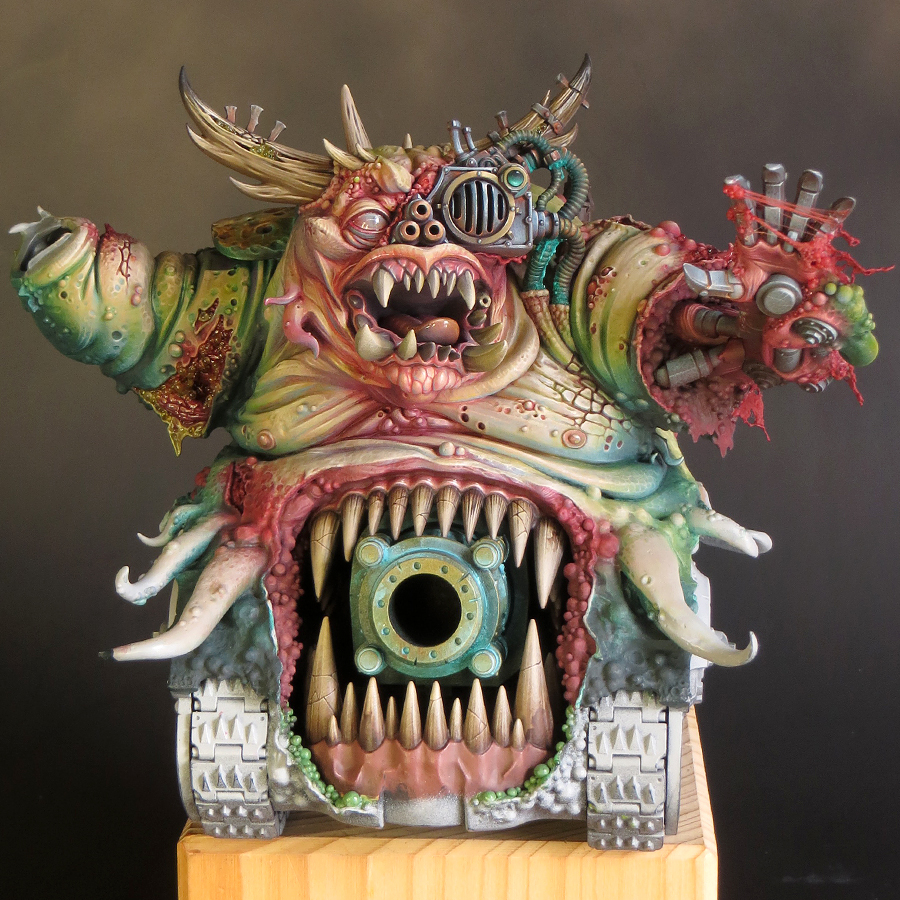
It’s been an intense few months of preparation and painting but I’ve finished my Daemon Engine in time for Golden Demon UK 2022, which is now upon us! I’m very proud of how this project has turned out because I’ve done the very best I can. It has been a brilliant experience but it’s now out of my hands and into the GD cabinet for judging. Fingers crossed!

So it’s time to reveal the finished Tank in its entirety. 

My planned pre-GD blog updates fell by the wayside. Once I’m back home and the GD dust has settled, I will upload a series of posts detailing the stages of this project to its completion.

Tuesday, 29 March 2022

Project P30 - Part 14.

So just when I though I’d be getting back into the swing of things, with a regular painting schedule, life had other ideas! We’d been planning some long-overdue house renovations (by long I mean 20 years!) and had scheduled them in for 2022. However the chance came to get the work done earlier and we took it. As a result our home was in complete upheaval, from October until mid-January, and there was no way on earth I could do any painting. Stressful as the disruption was it’s been great to finally get our bathroom and kitchen sorted and things are now getting back to normal, whatever that is.

The enforced hiatus has given me the opportunity to take stock and realise that I’ve undergone a big shift in attitude towards this project. Up until now I’ve been very focussed on getting the paint scheme for my Daemon Engine up and running. It’s been a sign of my uncertainty that I’ve concentrated on establishing the colours, textures, overall contrast and direction for the scheme but haven’t really looked beyond that.

Over the last month that has changed and I quite suddenly realised that I’ve now painted the bulk (no pun intended) of the flesh on this model. I have no firm idea of how long it will actually take to complete, but it feels like I’ve reached a sort of halfway point in the painting! I’m well aware that much of what remains to be done features fiddly mechanical details but I’ve most definitely moved forward into a new phase of the project.

When I started work on this project, back in February 2019, it was with the final model very much in mind. But as I’ve progressed, and especially since I’ve started painting, my thinking became more wrapped up with the process rather than the end goal. I think this was necessary because I needed to make a lot of decisions about what I was actually going to do with my scheme, but it did overwhelm my thinking.

With some major decisions made (I’m sure there are many more to come!) and considerable progress under my belt, I can now see my way ahead. So much so that I’ve started to work on a base for this model. The end of the project may be some way off but I think it’s a good time to start planning for it. The overall composition of this model and its base will make or break this project so there is no room for a last minute solution! I have plenty of time for planning and preparing a base and I fully intend to use it.

My thoughts on basing the model have greatly evolved over time. I’d thought of something quite large and elaborate, inspired by the type of basing you often see for historical tank kits. Thankfully I saw sense as that would have taken the project into diorama territory. What I now intend is to base the tank as though it were, and in many ways it is, a character model.

I’m not going to say too much about my basing plans until later in the project. But I must say a huge ‘thank you’ to Byron Orde who, through the course of a general discussion about basing, helped me to clarify my ideas. However, Byron went above and beyond that with some significant practical help towards getting this model onto the right base. I don’t like to blow my own trumpet but, with the help I’ve had from Byron, and if I can pull off all my plans, it’s going to be epic!

But all of that is in the future and for the moment I need to crack on with painting. I will go into more detail in my next posting but for the time being I will bring things up-to-date with a summary.

Back in October I painted the large horns on the Daemon’s head. This was straightforward but very fiddly. I then moved onto the mechanical left hand and arm. I’d made a good start on these when everything ground to a halt. 

At the end of February I was able to pick up my brushes again but decided not to go straight back to the hand. I decided to paint a sub-assembly to help me get back into the swing of things. For this I chose to paint the large chimney which I first had to detach from the model! This was not a fun job but well worth the bother as the chimney was much easier to paint as a separate element. 


With the chimney painted, I’ve now returned to painting the mechanical hand and arm.